

The Brahmaputra
Born of Himalayan ice in Tibet, the Brahmaputra sweeps into India as one of the great rivers of the world — so wide in places it resembles the sea. To sail it is to enter a corner of India still untouched by mass tourism, where rhinos graze the floodplains and monks dance on river islands.

A waterway of myth, monsoon and life
The Brahmaputra begins life as a glacial trickle high in the Himalayas of Tibet, where it is called the Yarlung Tsangpo. It enters India through Arunachal Pradesh as the Siang, then spills into Assam and becomes the braided, island-strewn giant that gives the state its lifeblood.
For the villages along its banks it is everything — road and market, fishery and faith. From the deck of a small ship you watch that life drift by: fishermen casting at dawn, ferries crowded with bicycles, elephants bathing at the shallows, and a horizon of tea gardens and blue hills beyond.
It is a river best travelled slowly, and best seen from the water — which is exactly how we have sailed it since 2003.

Among the world’s top 10 adventure cruises.— CNN
The course of the river
Our voyages trace the heart of the Brahmaputra through Assam — a string of temple towns, tribal villages, wildlife parks and river islands, each a world of its own.

A wildlife enthusiast’s paradise
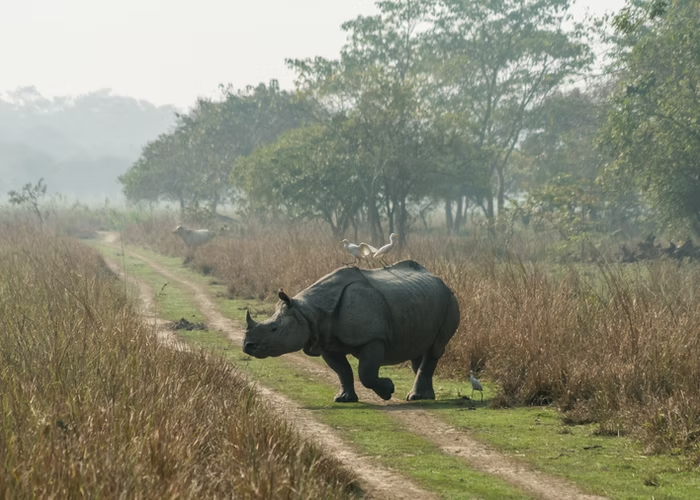
The Brahmaputra valley shelters seven national parks, including two UNESCO World Heritage Sites. Much of it can be seen from the ship’s deck — but the highlight is ashore, on a dawn jeep safari into Kaziranga.
This is one of the last strongholds of the great one-horned rhinoceros, alongside wild elephant, swamp deer, water buffalo and, if you are very lucky, the Royal Bengal tiger. Overhead, the skies fill with one of the richest birdlife in Asia.
The one-horned rhino
Over 2,600 rhinos roam the park — the densest population on earth.

Royal Bengal tiger
Kaziranga holds the highest density of tigers on earth — a rare and thrilling sighting from the jeep.

River dolphin
The rare Gangetic dolphin surfaces in the quiet channels off the bow.

Birdlife
Pelicans, storks, fish eagles and kingfishers — a birdwatcher’s dream.

A living tapestry of faith and craft
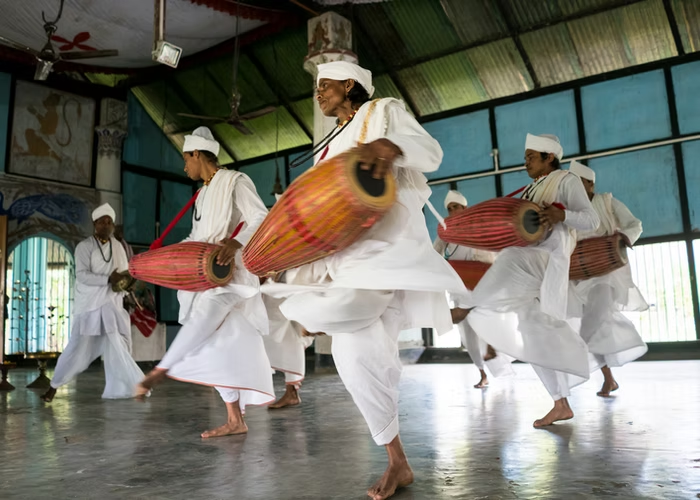
The river is a thread that ties together a remarkable diversity of cultures. On Majuli, the great river island, saffron-robed monks keep alive a 500-year-old monastic tradition of dance, music and mask-making in the satras.
Ashore, you meet Mishing tribal weavers at their looms, share tea with a planter on a colonial veranda, watch silk spun in a village workshop, and climb to the hilltop Kamakhya Temple, one of the most sacred shrines in all of India.
Stops along the Brahmaputra
Every mooring opens onto a different Assam — temple towns, tribal villages, wildlife parks and the world’s largest river island.

Guwahati
Assam’s riverfront capital and the hilltop Kamakhya Temple — one of India’s most revered shrines, alive with ritual at dawn.

Tezpur & the banks
The “city of eternal romance,” ringed by ancient ruins, tea estates and the blue silhouette of the Eastern Himalaya.
Kaziranga
A dawn jeep safari into the floodplains in search of the one-horned rhino, wild elephant and Bengal tiger.

Majuli
The world’s largest river island, home to the Vaishnavite satras — monasteries of dancing monks and mask-makers.

Sivasagar
The seat of the 600-year Ahom dynasty — royal tanks, temples and palaces from a kingdom that never fell to the Mughals.

Jorhat
The heart of the world’s greatest tea-growing region — a guided walk and tasting on a working colonial estate.
What you’ll experience
- A dawn jeep safari for the one-horned rhino in Kaziranga
- The dancing monks and mask-makers of Majuli Island
- Sunrise at the hilltop Kamakhya Temple, Guwahati
- A guided walk and tasting on a working tea estate
- Mishing tribal villages and riverside weavers
- The royal tanks and temples of Ahom-era Sivasagar
- Silk-weaving villages and craft traditions of Assam
- Birdwatching by skiff along quiet river channels
- Sunset sailing with a traditional Assamese feast on deck
- Blue hills, tea gardens and a horizon that never repeats
The Brahmaputra’s seasons
We sail from October to April, when the river is calm after the monsoon, the skies are clear and the wildlife is at its most visible.
Early season
Lush green floodplains after the monsoon and warm, comfortable days.
Good sailingPeak season
Crystal skies, cool mornings and the very best wildlife viewing.
Best time to sailLate season
Warmer days, fewer travellers, and the tea gardens in first flush.
Good sailingMonsoon
The river rises and rests — we return to the water in October.
Off seasonBrahmaputra voyages
From a four-night taster to a week-long expedition — each aboard our flagship, ABN Charaidew II.

.avif)

ABN Charaidew II
Our newest Brahmaputra flagship carries up to thirty-six guests in eighteen river-view cabins — hand-built in the colonial tradition, with a teak sundeck, gym and spa, and an extra-shallow draught that reaches islands larger ships can only pass by.
She is a country house that floats: slow mornings, regional cooking, a naturalist and historian aboard, and the river drifting past every window.
A photo essay
On the river Riverside
 Dining aboardTea country
 Time ashore
 Aboard Charaidew II
Sail the Brahmaputra with us
The original river-cruise line in North-East India — sailing these waters since 2003.